Introduction
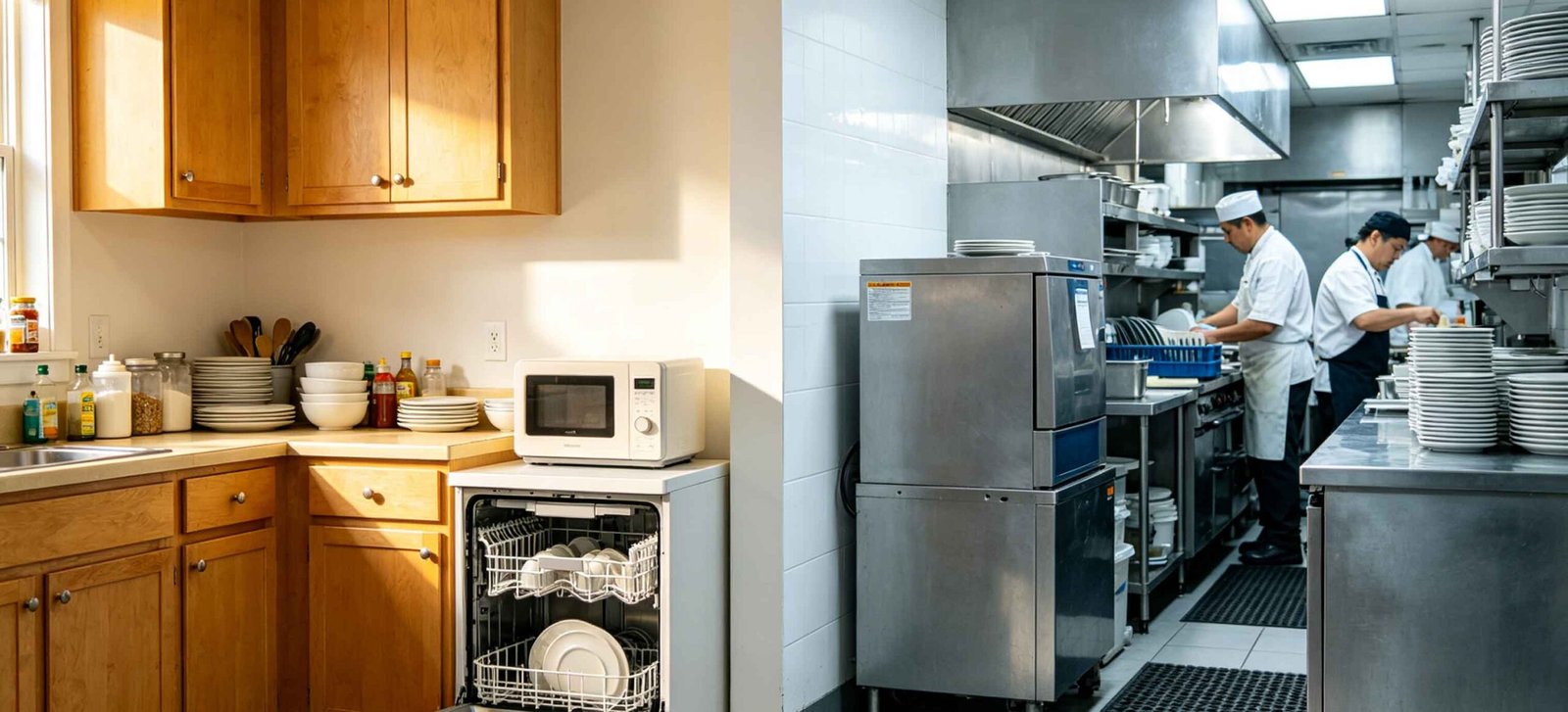
Dishwashers fall into two core categories: household domestic dishwashers for family kitchens and commercial/industrial dishwashers built for restaurants, hotels, cafeterias and catering facilities. While both complete tableware cleaning tasks, they differ drastically in design structure, working capacity, sanitation standards, energy-water consumption and service lifespan, tailored to entirely separate usage scenarios. This article systematically breaks down their key distinctions from multiple practical dimensions.
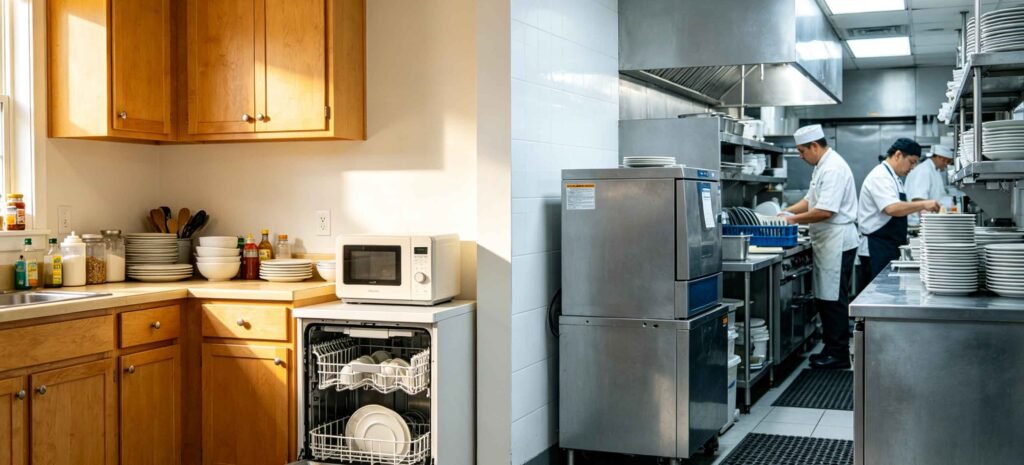
1. Daily Processing Capacity & Working Cycle
Home dishwashers are engineered for small-scale domestic use. A standard household model holds 12–16 place settings, with a full wash cycle ranging from 60 minutes up to 3 hours. Families run the machine only 1–3 times per day after three daily meals, featuring intermittent idle time between uses.
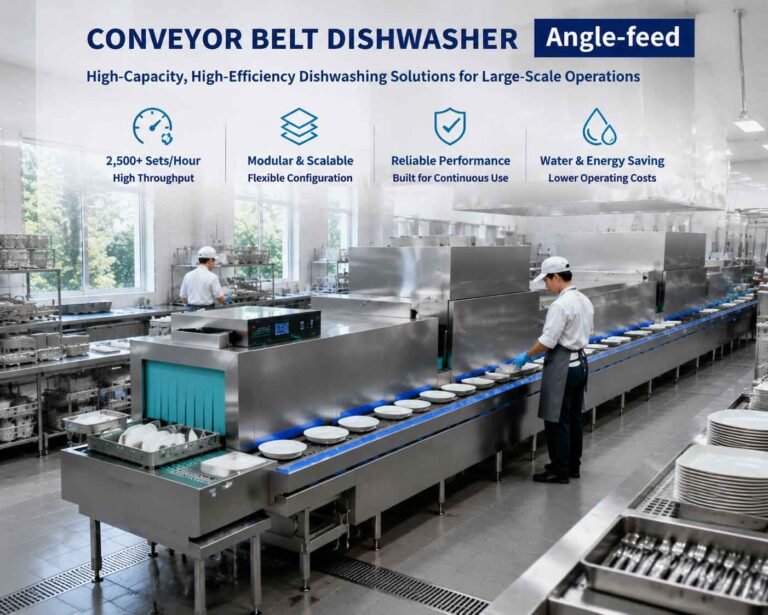
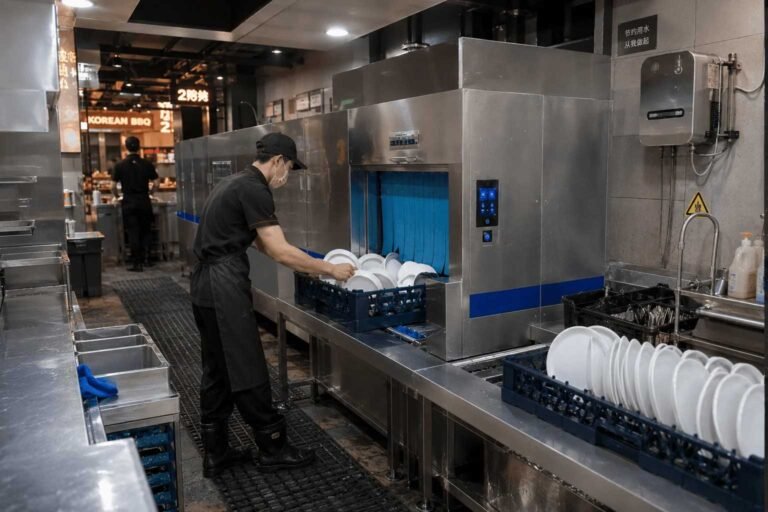
By contrast, commercial dishwashers (rack, conveyor or undercounter types) focus on high-volume continuous cleaning. Conveyor industrial units can clean hundreds of dish racks hourly, processing dozens of full tableware sets every minute. In busy restaurant peak hours, the equipment runs nonstop for 8–12 consecutive hours without shutdown, matching massive tableware turnover from dine-in customers and banquets.
2. Sanitation Standard & Disinfection Technology
Sanitation requirements mark one of the most critical gaps. Household dishwashers mostly operate at 45℃–55℃ washing temperature, relying on detergent for basic decontamination; their optional high-temp mode rarely exceeds 70℃, only satisfying daily household hygiene needs with no mandatory food-grade disinfection regulations.
Commercial units follow global catering codes like HACCP and local food safety laws. Most commercial dishwashers adopt high-temperature sanitization: final rinse water hits 82℃ or above to kill harmful bacteria such as E.coli and salmonella thoroughly. Some models equip chemical sanitizing modules as an alternative, ensuring tableware passes regular health inspections for food service businesses.
3. Water, Energy & Resource Consumption Design
Home appliances prioritize water-saving for low-frequency use: a full load consumes roughly 9–15 liters of water, with low-power heating elements suited for residential household voltage. Their design centers on daily family utility bill control.
Commercial dishwashers adopt recycled circulating water filtration systems to cut waste amid continuous operation. Though instantaneous water heaters consume higher instant power to maintain constant high rinse temperature, the recycled water structure lets them use far less water per single dish piece than hand washing or home-sized equipment. Long-running daily usage makes their overall energy layout optimized for long-term catering cost reduction instead of short-term household conservation.
4. Build Quality, Durability & Service Life
Household dishwashers use thin stainless steel or plastic inner liners, built to withstand around 5–8 years of sporadic daily use under low working intensity. Internal parts like pumps and spray arms are made for light load domestic wear and tear.
Commercial dishwashers feature full thick-gauge 304 stainless steel bodies and heavy-duty industrial-grade motors, pumps and bearings. Designed to endure years of all-day continuous operation, their average service lifespan reaches 10–15 years. Modular spare part structure also enables quick on-site maintenance to minimize kitchen downtime during breakdowns.
5. Installation, Space & Functional Configuration
Domestic dishwashers come as built-in or freestanding compact units, fitting standard home cabinet dimensions, connecting to regular domestic cold/hot water taps and common household electricity sockets. Functions focus on flexible modes: eco-wash, quick wash, delicate glassware wash for varied home tableware like fragile porcelain and plastic containers.
Commercial variants have diversified sizing: large conveyor types occupy dedicated back-kitchen space, compact undercounter versions fit small café bar counters. Most require professional plumbing, commercial high-power wiring and dedicated drainage pipelines. Function-wise, they separate dedicated cycles for dinner plates, heavy pots & pans and wine glassware to meet differentiated cleaning needs across catering kitchens.
Conclusion
In short, home dishwashers serve flexible, low-intensity family daily life with economical compact design, while commercial dishwashers are specialized industrial equipment built around high efficiency, strict food sanitation and long-lasting heavy-load performance for the hospitality industry. Clarifying these differences helps restaurant operators and household buyers pick the right dishwasher matching their actual usage demand.