A second-hand commercial dishwasher appears to be a budget-friendly option for catering businesses with limited upfront capital. However, it comes with numerous hidden risks, performance flaws, extra operational expenses and critical after-sales shortcomings. Most used units have endured long hours of high-intensity operation, featuring worn internal components, unknown service and repair histories, and no valid manufacturer warranty. This article outlines the key disadvantages covering equipment reliability, daily operation, maintenance costs and after-sales support.
1. Uncertain Equipment Condition & Hidden Internal Defects
Most second-hand dishwashers are retrieved from busy restaurants and institutional canteens, operating continuously under heavy loads. External appearance rarely reflects true internal condition. Most units carry latent wear and hidden faults that cannot be identified through simple visual inspections or short trial runs.
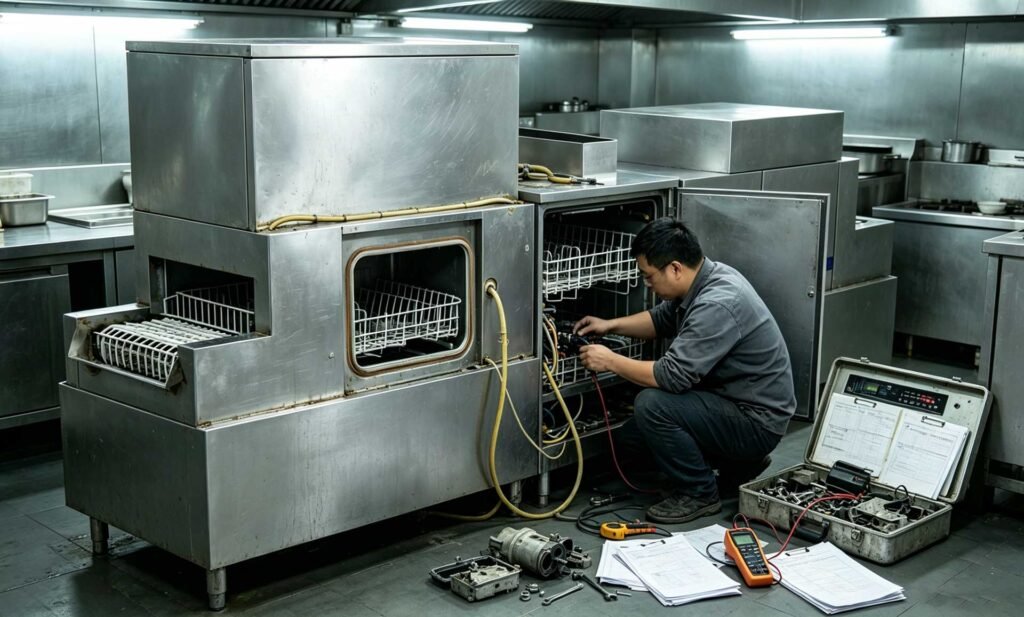
Core wearable components, including circulation pumps, heating elements, motor bearings, seal gaskets and temperature sensors, typically suffer severe aging and fatigue after prolonged commercial use. They may function normally during a quick test but fail frequently during daily high-volume operations. Additionally, many used machines have undocumented repair records; some are poorly refurbished with low-quality replacement parts or repaired after major faults such as water ingress and short circuits, resulting in unstable long-term performance.
Furthermore, long-term operation in humid, soapy environments leads to accumulated limescale, grease residue and bacterial buildup inside tanks and pipelines, which cannot be fully eliminated through basic cleaning. This creates persistent hygiene hazards that may cause failed health inspections, operational fines or mandatory business rectification.
2. Degraded Working Performance & Low Operational Efficiency
Component aging inevitably downgrades overall equipment performance. Common issues include fluctuating water pressure, weak spray coverage, inaccurate temperature readings and slow heating cycles. Inconsistent washing and sanitizing results in substandard tableware cleanliness, failing to meet commercial catering hygiene requirements.
Most second-hand models are outdated with low energy efficiency. They consume significantly more water and electricity than modern energy-efficient units. Over time, inflated utility bills easily offset the initial cost savings, creating a “cheap to buy, expensive to run” scenario. Frequent breakdowns also lower operational throughput, cause tableware backlogs during peak hours and negatively impact customer experience.
3. High Hidden Maintenance & Replacement Costs
Used commercial dishwashers have a substantially higher failure rate than new equipment. Common recurring issues include motor aging, seal leakage, pipeline blockages and control system malfunctions. Unlike new machines covered by manufacturer warranty, all inspection, repair, part replacement and labor costs fall entirely on the buyer.
Many older dishwasher models have discontinued original spare parts. Operators can only source costly universal or refurbished components, which have shorter lifespans and require frequent replacement. In many cases, cumulative annual maintenance costs exceed the price gap between used and new units, eliminating all initial budget advantages.
4. Serious After-Sales Service Vacancy & Zero Warranty Guarantee
The lack of reliable after-sales support is the most critical downside of purchasing second-hand dishwashers. Almost all used catering equipment is sold in “as-is” condition, with no valid manufacturer warranty, no official service contract and zero guaranteed technical support.
Original factory warranties are fully expired, and manufacturers refuse to provide official maintenance, fault diagnosis or complimentary part replacements. Most second-hand dealers only offer basic delivery services without ongoing after-sales care. When breakdowns occur, users must rely on uncertified third-party technicians with no standardized service quality assurance.
There is no formal emergency response mechanism for sudden failures. Unexpected breakdowns during peak business hours or holidays often lead to prolonged downtime and substantial revenue losses. Unlike new equipment that comes with regular official inspections, routine maintenance guidance and professional debugging support, used dishwashers offer no follow-up technical assistance.
5. Poor Safety & Hidden Operational Risks
Long-term operational wear causes circuit aging and degraded wire insulation, greatly increasing risks of short circuits, current leakage and electric shocks in humid kitchen environments. Aging pressure pipes and failed seals may also result in water bursts or steam leaks, posing serious safety threats to on-site staff.
Additionally, many second-hand units have unprofessional circuit or pipeline modifications that violate commercial safety standards. Such non-compliant equipment may fail official safety audits, leading to equipment confiscation or temporary business suspension.
6. No Resale Value & Low Upgrade Compatibility
Outdated dishwasher models are incompatible with modern intelligent control systems, energy-saving upgrades and functional expansions. As catering industry hygiene and energy efficiency standards continue to update, old equipment will gradually become obsolete. Severely aged second-hand units also retain almost no resale value and can only be scrapped at low prices, causing irreversible asset loss for businesses.
Summary
While second-hand commercial dishwashers lower initial procurement costs, they bring long-term hidden drawbacks including frequent failures, high maintenance expenses, excessive energy consumption, absent after-sales support and potential safety hazards. For stable and sustainable catering operations, second-hand dishwashers are uneconomical and unreliable overall. The absence of official warranty and professional after-sales service remains the leading cause of continuous operational losses.